 Skip to content


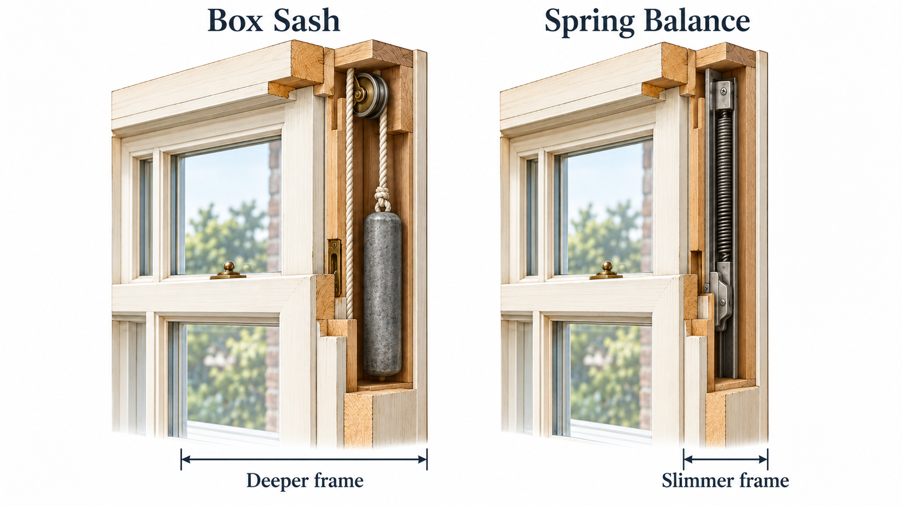
A box sash window uses heavy weights on cords, hidden inside a hollow frame, to balance the sliding part of the window. A spring balance window does the same job with a spring tucked into the side of the frame, which means the frame can be far slimmer.
Here’s the short answer. If your house is listed, or you’re replacing the original windows on the front of a period property, you want box sash. If you’re working to a budget, fitting into a shallow opening, or sorting out the back of the house, spring balance is a sensible choice.
Both are good windows. They suit different jobs. The rest of this article explains why, so you can tell which one you’re being quoted for and whether it’s the right call.
Pick up a sliding sash window and you’ll notice something odd. It’s heavy, but it stays exactly where you leave it. It doesn’t slam shut or creep down on its own.
That’s because there’s a counterweight doing the work. The outer frame is hollow, like a tall narrow box built into the wall on each side of the window. Inside each side hangs a weight, usually cast iron or lead, on a length of cord. The cord runs up the inside of the box, over a small wheel at the top called a pulley, and across to the edge of the sliding sash.
The weight matches the weight of the sash. So when you push the window up, the weight comes down, and the two balance each other out. Let go at any point and it stays put.
It’s a three-hundred-year-old idea and nobody has improved on it, which tells you something. The design has one other advantage that matters more than people realise.
Every part of it can be replaced. Cords eventually fray and snap, which is the most common fault we see in old sash windows, and a new cord is a straightforward job. The weights themselves last indefinitely. We’ve reused iron weights that went into houses before the First World War.
The catch is space. All that machinery needs somewhere to live, so the frame has to be deep. If you’re putting a box sash into an opening that was built for one, that’s no problem. If the opening is shallow, it can be.
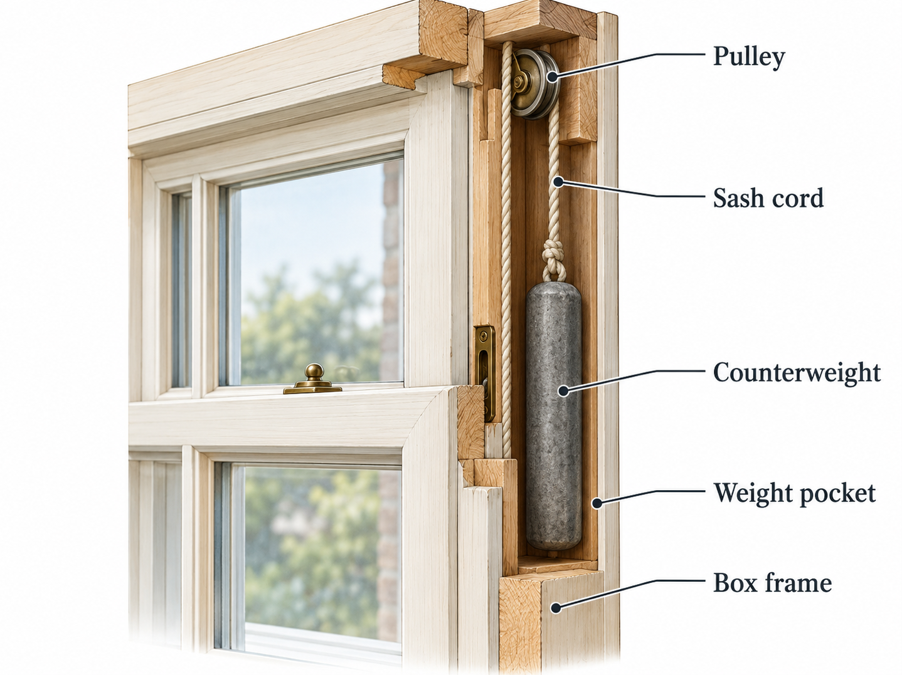
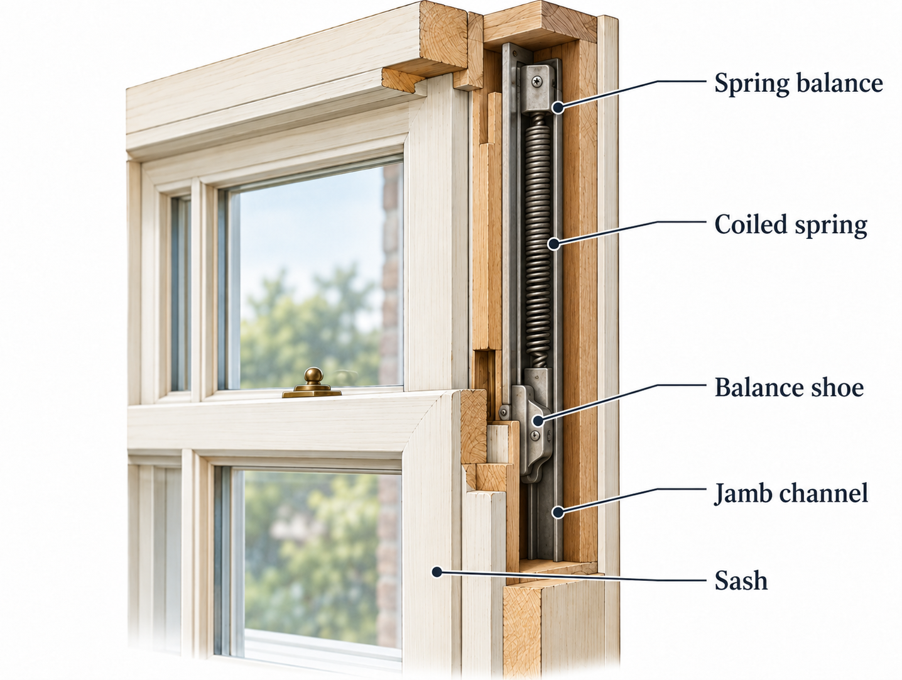
A spring balance does the same job in a fraction of the room. Instead of a weight on a cord, there’s a spring mechanism concealed in a channel at each side of the frame. It’s tensioned to match the weight of the sash, so the window behaves the same way when you slide it. No box, no weights, no pulleys.
Because there’s no hollow frame to accommodate, the whole window is slimmer. That makes spring balances useful when you’re fitting a sash window into an opening that was never designed for one, or when the existing reveal is too shallow for a box frame. They also cost less and go in more quickly.
The trade-off is that a spring is a moving part with a working life. After a couple of decades, it loses tension and the window starts to drift, and at that point the balance is replaced rather than repaired. It’s not a difficult job, but it is a job, and it will come round again. A cast iron weight has no working life. It just hangs there being heavy.
There’s also the matter of what they look like. A good spring balance sash from a decent workshop looks convincing. Up close on a Georgian front elevation, somebody who knows windows will spot that the frame is too slim for the period.
| Box sash | Spring balance | |
| How it balances | Weights on cords inside a hollow frame | A tensioned spring in the side of the frame |
| Frame depth needed | Deep | Shallow |
| Right for a period property? | Yes, this is the original design | Convincing, but the frame is slimmer than the period |
| Accepted on listed buildings | Normally expected | Rarely accepted |
| Cost | Higher | Slightly less |
| How long the mechanism lasts | Cords last decades and are cheap to replace. Weights last forever | Springs typically need replacing after around 10+ years |
| If something goes wrong | Replace a cord, usually in under an hour | Replace the balance unit |
| Fitting into an existing shallow opening | Difficult or impossible | Straightforward |
| How it feels to use | Smooth, with a reassuring weight to it | Lighter, slightly springier |
| Getting spare parts in 30 years | Cords and weights will always be available | Depends on the manufacturer still making that unit |
The pattern is reasonably clear. Box sash costs more and lasts longer. Spring balance costs less and fits where a box frame won’t.
If your property is listed, assume box sash. Conservation officers will normally expect the replacement to copy the original in the way it’s built as well as the way it looks, and the original was almost certainly a box sash.
Conservation areas are more varied. A lot depends on which elevation you’re talking about. We’ve had plenty of jobs where the council wanted box sash across the front of the house and had no objection to spring balances at the back, where nothing is visible from the road. Some authorities are stricter than that. Some barely engage.
We deal with the conservation teams at Liverpool City Council, Wirral and Sefton often enough to have a reasonable sense of what each one will accept, though we’d never promise an outcome on their behalf. If you’re in a conservation area, it’s worth a phone call to the council before you commit to anything. They’d far rather have that conversation with you early than issue an enforcement notice later.
For more information about replacing windows in a conservation area, read our detailed guide.
Spring balance windows cost noticeably less than the equivalent box sash. The gap comes from the frame, which uses less timber and takes less time to make, and from the mechanism itself.
Over the life of the window the sums look different, because you’ll replace the balances at least once and probably twice. Whether that matters depends on how long you plan to be in the house.
This comes up a lot, usually from people hoping to save money on a window that’s otherwise sound.
Converting a box sash to spring balances is possible. The weights come out, the pockets get filled, and balances go into the sides. We’d generally talk you out of it. You’re taking a window that can be repaired forever and giving it a component that will need replacing, and you’re not saving much, because most of the cost is in the frame and sashes that you’re keeping anyway.
Going the other way is harder. A spring balance frame doesn’t have the depth to take weights and pulleys, so converting it usually means a new frame, at which point you’re buying a new window.
If the problem is that your sash windows don’t slide properly, the answer is often much simpler than either of these. Worn cords, painted-shut sashes and swollen beads cause most of the complaints we hear, and they’re all fixable.
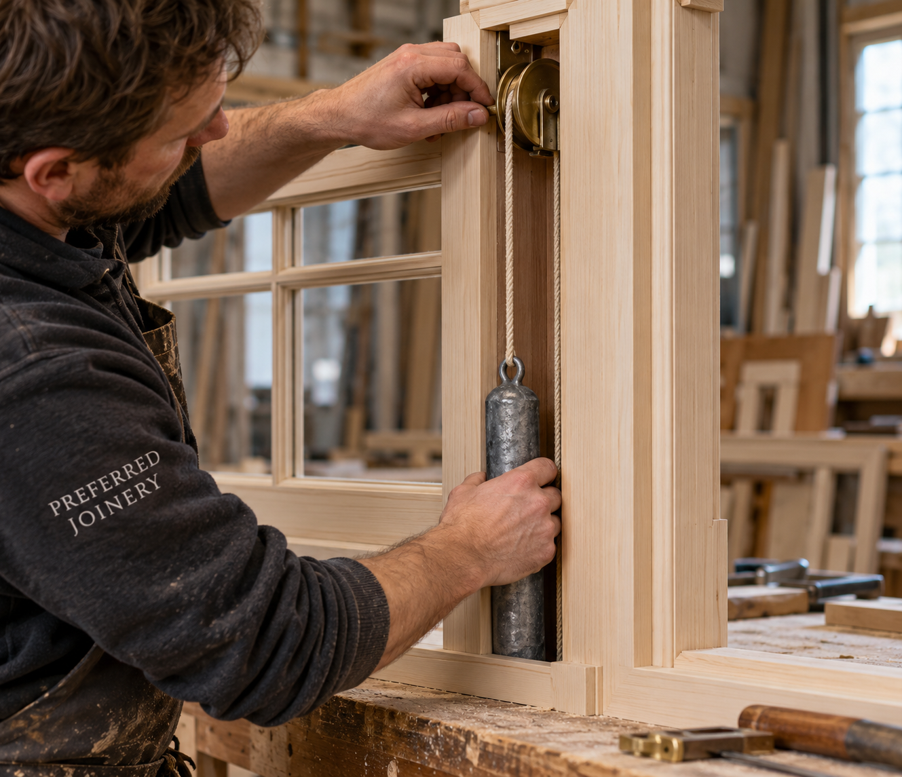
Our default for a period property is box sash with cords and weights. It’s what the house was built with, it’s what looks right, and it’s what we’d want in our own homes.
We recommend spring balances when there’s a practical reason for them. A shallow opening that won’t take a box frame. A rear extension where matching the front of the house doesn’t matter. A budget that has to stretch across eight windows rather than four, where we’d rather fit eight good spring balance sashes than four box sashes and leave the rest rotting.
If you’re unsure which you’ve got at the moment, look at the thickness of the frame around the window from the inside. A box sash frame is noticeably chunky. Or send us a photograph and we’ll tell you.
We’ve been making bespoke timber windows in our Liverpool workshop since 1997. Every sash we make is designed and built to measure for the opening it goes into, then fitted by our own team across Liverpool, the Wirral, Runcorn, Warrington, Southport and Skelmersdale.
Call us on 0151 707 9999, email info@preferredjoinery.co.uk, or request a brochure.
What is a box sash window?
A sash window where the sliding panels are balanced by weights hanging on cords inside a hollow frame. The frame is built like a tall narrow box, which is where the name comes from. It’s the traditional design and it’s what you’ll find in most Georgian, Victorian and Edwardian houses.
Are spring balance sash windows any good?
Yes, when they’re well-made and used in the right place. They slide properly, they look like sash windows, and they fit into openings where a box frame won’t go. The spring needs replacing every couple of decades, and they’re not usually accepted on listed buildings.
How long do sash cords last?
Typically, several decades, though it depends on how often the window is opened and whether the cords have been painted over. When one goes, replace the cords on both sides at the same time, because the other won’t be far behind.
Can you repair a spring balance sash window?
The balance unit itself is replaced rather than repaired. It’s a quick job if the same unit is still available from the manufacturer. If it isn’t, a competent joiner can usually fit an equivalent.
Do box sash windows need more maintenance?
No. They need repainting like any timber window, and a cord every few decades. The mechanism has no components that wear out in the way a spring does.
What is a sash and case window?
The Scottish name for a box sash window. “Sash” is the sliding panel and “case” is the hollow frame. Same window, different term, and you’ll see it used throughout Scotland and occasionally in the north of England